You're Not Bad at Time. Your Brain Perceives It Differently.
Time blindness is one of the most misunderstood aspects of ADHD. Dismissed as poor organisation, blamed on laziness, or managed with planners that miss the point entirely. The real problem isn't a lack of systems. It's a difference in how the brain perceives time itself. Once you understand the mechanism, the solutions look very different.
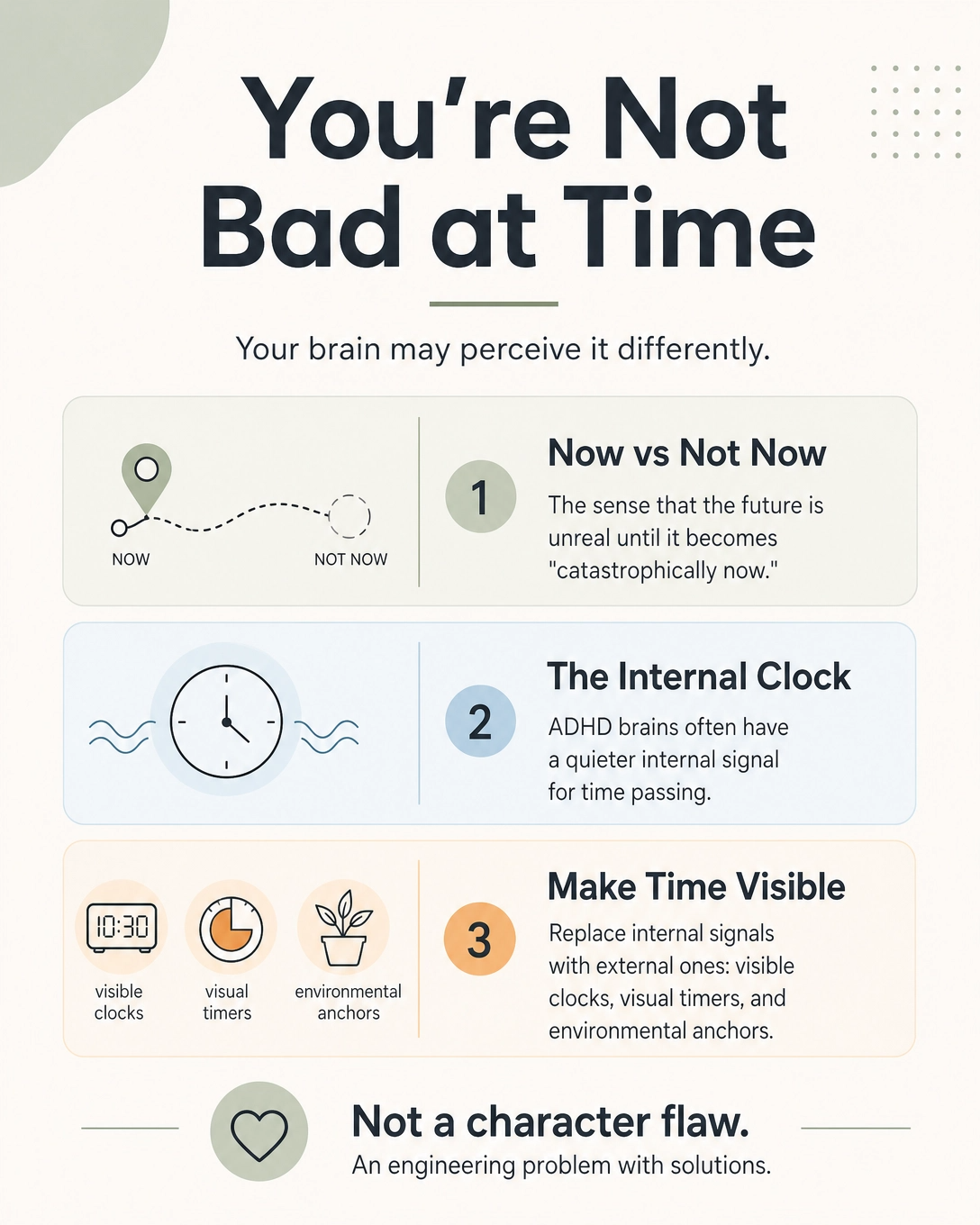
How time works for ADHD’rs
Let me describe a scenario that might be familiar.
It's Tuesday morning. You have a meeting at 2pm. You know about it. It's in your calendar. You've seen the reminder. And yet, somehow, you look up at 1:58pm and feel a jolt of shock. Not because you forgot the meeting, but because the two hours between your morning and that moment simply didn't register as real time passing.
This isn't forgetfulness. It isn't disorganisation. And it is definitely not a character flaw.
It's time blindness. One of the most commonly misunderstood features of the ADHD brain. And until you understand what's actually happening neurologically, every system you try to fix it will address the wrong problem.
How most people experience time
For most people, time is something they can feel. Not with precision, nobody has a stopwatch running in their head, but there's a continuous low-level awareness of time passing. A rough internal signal that says: it's been about twenty minutes, or the morning is nearly gone, or I need to start wrapping this up.
This signal is quiet, mostly unconscious, and remarkably reliable for neurotypical brains. It means they can estimate how long a task will take with reasonable accuracy. They can feel themselves getting close to a deadline. They can sense, mid-conversation, that the meeting is probably nearly over.
None of this requires effort. It just runs in the background. Like a clock they can glance at internally whenever they need it.
What happens in the ADHD brain
Research consistently shows that ADHD is associated with impaired time perception. This isn't about intelligence, memory, or effort. It's about a difference in how the brain processes the passage of time at a neurological level.
The internal clock that most people rely on is less reliable in the ADHD brain. Which means the continuous background signal (the sense of time moving, of the morning passing, of a deadline approaching) is simply quieter. Or absent.
The result is a time experience that many ADHD adults describe the same way, in almost the same words: there is now, and there is not now. That's it. That's the whole spectrum.
The meeting in forty minutes? Not now. The deadline next Friday? Not now. The appointment you booked three weeks ago for tomorrow? Not now. Right up until the moment it becomes, with no warning, catastrophically now.
This explains patterns that can otherwise seem baffling: being chronically late despite caring about punctuality. Consistently underestimating how long things take. Starting tasks at the last possible moment not because you're lazy but because the task didn't feel real until the urgency made it so. The shock of 1:58pm, even when you've known about the 2pm meeting all day.
“There is now, and there is not now. The meeting in forty minutes? Not now. The deadline next Friday? Not now. Until it is catastrophically now.”
Why the standard advice doesn't work
When time blindness gets recognised at all, the advice it generates tends to be some version of the same three things: use a planner, set reminders, be more organised.
This advice isn't wrong, exactly. A planner does help. Reminders do help. But they address the symptom without understanding the mechanism which means they help incompletely, and when they fail (as they often do), the person is left blaming themselves rather than the design of the solution.
Here's the problem: a reminder that tells you a meeting is in ten minutes still requires you to believe, at a neurological level, that ten minutes is real. If your brain doesn't have a functional internal clock, the notification becomes a data point rather than a felt urgency. You see it. You acknowledge it. You go back to what you were doing. And then you look up at 1:58pm.
The gap between knowing and acting on time-based information isn't closed by more information. It's closed by changing the form that information takes. From something your brain reads to something your brain can actually feel.
What actually works: making time visible
The principle behind every effective time blindness accommodation is the same: replace the missing internal signal with an external one your brain can actually perceive.
That means making time visible, not just knowable, but present in the environment in a way that the brain registers without having to seek it out.
⏱️ Clocks on every wall.
Not a phone that has to be unlocked, or a watch that requires a deliberate glance but clocks positioned so that time is part of the visual field throughout the day. The ADHD brain doesn't go looking for time data; it needs time data to be present in the environment whether it's looking or not.
⏱️ Time timers.
A time timer (or any visual timer that shows duration as a physically depleting space) does something a digital countdown can't: it makes the passage of time visible. The red arc getting smaller is easier for the brain to perceive as real than the number 23:47 getting smaller. One is spatial and continuous. The other is abstract and requires cognitive processing to interpret.
⏱️ Narrating transitions out loud.
This sounds unusual but it works. Saying out loud, "I'm finishing this and moving to the next thing" as you do it creates an external signal at the transition point — one that the brain registers differently than a purely internal thought. For many ADHD brains, verbalising the transition makes it more neurologically real.
⏱️ Time anchors in the environment.
Tying work periods to sensory or environmental cues rather than clock times: "I work until the second coffee is finished" or "I stop when the playlist ends", uses external, perceivable signals as time boundaries rather than abstract numerical ones. These work not because they're clever hacks but because the brain responds to them as real markers in a way it doesn't respond to "work until 11am."
A word about the shame that comes with this
Time blindness is one of the ADHD symptoms that carries the most shame partly because it's so visible to other people (lateness, missed deadlines, forgetting appointments), and partly because it so closely resembles carelessness or disrespect.
It looks like you didn't care enough to be on time. It looks like you didn't respect the other person's time. It looks like you weren't trying.
And because it looks like that (from the outside, and sometimes from the inside too) most people with ADHD have spent years apologising for it, trying to compensate for it, and blaming themselves for something that is neurologically structural.
The distinction that matters: you are not bad at time. Your brain perceives it differently. That's not the same thing.
One of those is a character failing. The other is an engineering problem. And engineering problems have solutions.
The design question to sit with
If you're building or rebuilding your time systems, the useful question isn't "what tool should I use" it's "what would it take for my brain to actually feel time passing, rather than just know it intellectually?"
The answer is personal. Some people find visual timers transformative. Others find that working with background music structured into timed blocks (so the end of a playlist is a real felt signal) works better. Others find that frequent environmental cues (stepping outside, making a drink etc) anchor them to the passage of time in a way pure clock-watching never does.
The goal in every case is the same: move as much of your time-awareness out of your head and into the environment around you. Stop relying on an internal signal that isn't reliably there. Build the external scaffolding that does the job instead.
That's not a workaround. That's building for the brain you actually have.
REFLECT
What’s your relationship with time and what’s the one external signal that most reliably keeps you anchored to it?
Working with an ADHD coach means building systems that work for your brain not ones that assume a neurotypical relationship with time, focus, or motivation. If you’d like to explore what that looks like in practice, a free 25-minute discovery session is a good place to start.
Home